Range Repair
Wolf Gas Oven Igniter Clicking but Not Lighting: What to Check
A gas oven or burner igniter that clicks without lighting is usually wet, coated in grease, or sparking at a burner cap that sits off center; if it lights and keeps clicking, the module cannot sense the flame. Turn the knob off after five seconds without flame and let the gas clear first.
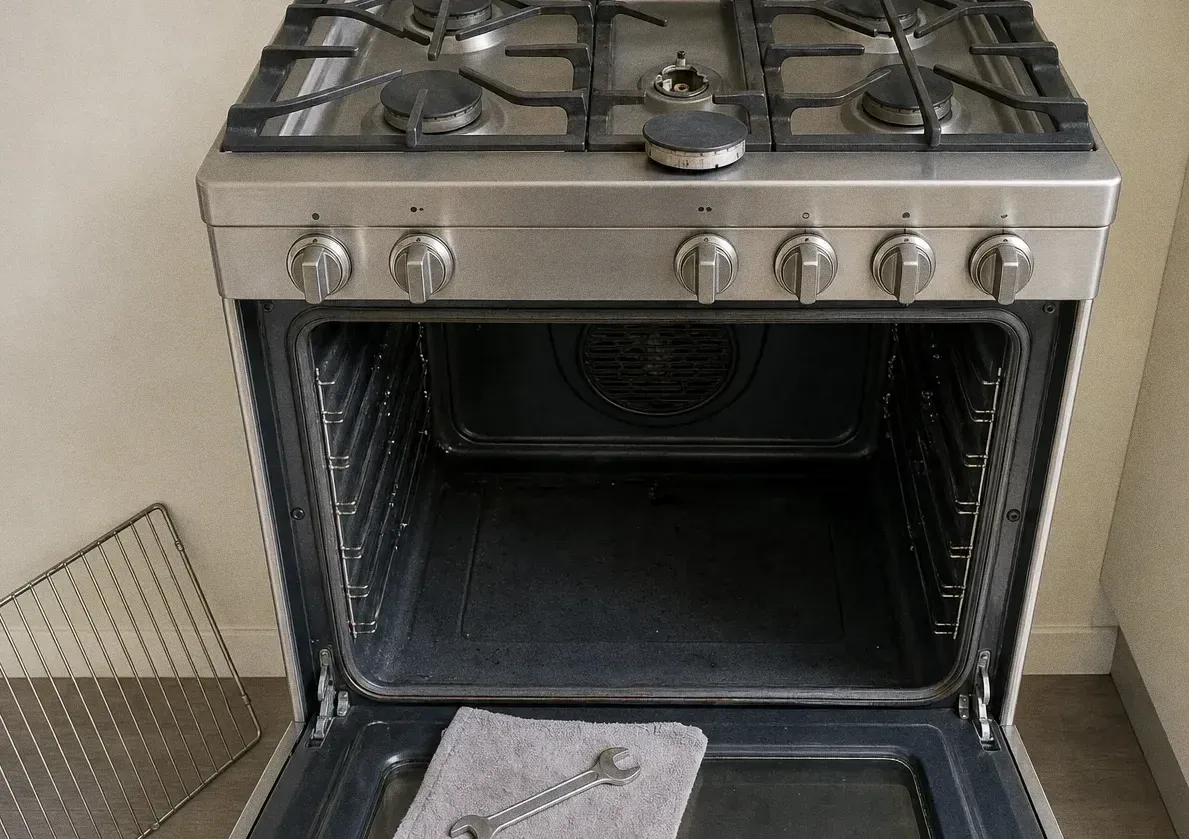
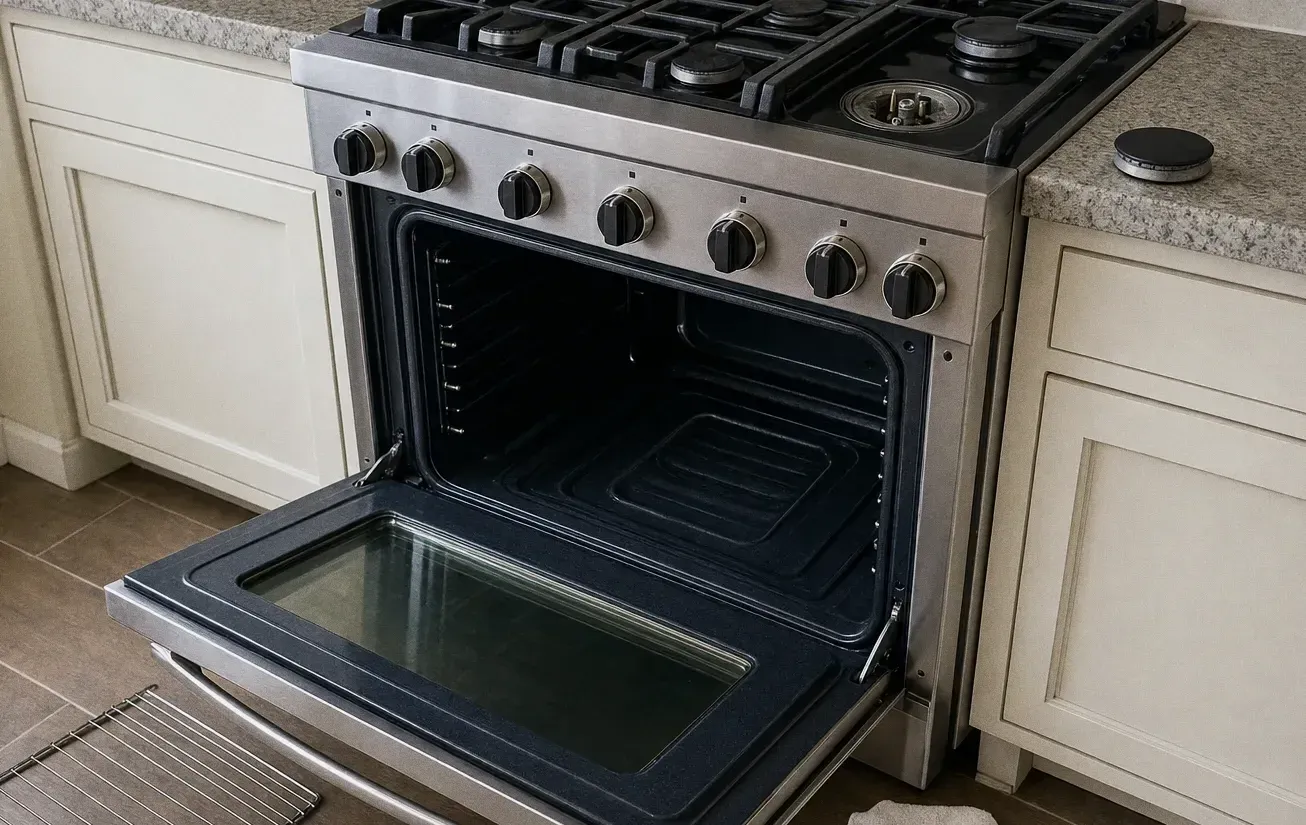
Clicking with no flame means the spark is firing but the gas is not catching, or the gas is catching and the control never notices. On a Wolf range the cause is usually ordinary: water from a boil-over or a freshly wiped cooktop, a film of grease on the white ceramic electrode, or a burner cap sitting an eighth of an inch off its base. Less often a spark module or knob switch has failed. If nothing lights within about five seconds, turn the knob off, wait five minutes for the gas to disperse, and only then try again.
Find out which part is actually clicking
Start with the kind of range you own. A dual-fuel Wolf pairs gas burners on top with an electric oven below, so its oven never clicks; any sparking you hear belongs to the cooktop. An all-gas range burns gas in both places, and its oven lights in one of two ways: with a spark electrode like the burners, or with a hot-surface igniter that glows orange before the gas valve opens.
Next, turn a single knob and watch rather than listen. On most sealed-burner ranges every electrode sparks together whenever any knob reaches the light position, so a burner you are not using can be the one rattling away. Look for a crisp blue spark at each burner; one with a weak, yellowish spark, or none, is your suspect.
The 48- and 60-inch ranges found in many Weston kitchens have two oven cavities, each with its own burner and igniter. Test them separately, since a fault in the large oven says nothing about the small one.
Burners that click and will not light
Moisture is the usual culprit. A boil-over, a damp sponge pushed around the burner base, or spray cleaner running down the electrode leaves water where the spark needs a clean path to the cap, so it tracks to ground instead of meeting the gas. Lift off the grate and cap, blot what you can, and leave the parts off for several hours, or overnight after a heavy spill.
Grease and carbon come next. Food baked onto the ceramic tip insulates it, so the spark grows faint or jumps somewhere useless. With the power off, scrub the tip gently with a dry toothbrush. Check the burner ports as well, because a clogged port beside the electrode starves it of gas; clear it with a straight pin rather than a wooden toothpick, which can snap off inside.
Then look at the cap. Wolf caps sit on a machined base and should rest flat without rocking. One shifted during cleaning lets gas escape in the wrong place, and the spark fires into empty air.
Burners that light and keep clicking
A burner that lights and then keeps clicking is a separate fault. Wolf cooktops relight a flame that goes out, so the module watches for flame through the electrode and sparks whenever it cannot detect one. Moisture, a dirty tip or a cap off center are again the usual causes. Clicking with every knob off points to a wet or failed knob switch; erratic clicking from all burners once everything has dried points to the spark module. A reversed-polarity or poorly grounded outlet can mimic both, and a meter settles which.
Inside the oven: clicking, or a glow with no flame
A spark-lit oven should catch within a few seconds of the click. If it sparks and nothing happens, either gas is not arriving or the spark is not crossing its gap. On an all-gas range the burners on top draw from the same supply, so working burners mean the household gas is fine and the trouble lies in the oven circuit.
A hot-surface oven that glows but never lights almost always has a tired igniter. The igniter and the oven safety valve are wired in series, and the valve opens only once enough current flows through the glowing element. As the igniter ages its resistance climbs, so it can glow brightly while passing too little current to open the valve. A healthy one can take up to about ninety seconds; a glow that runs well past that, every time, means the part is worn out.
Never try to light an oven burner by hand. The cavity is enclosed, and gas that has collected inside can ignite all at once.
Where owner checks end and gas safety begins
Drying, brushing, reseating caps and watching are all fine for an owner, provided the breaker is off or the range is unplugged before you touch an electrode, since a spark module delivers a sharp high-voltage pulse.
Stop trying and arrange service if any of these happen:
- You smell gas near the range or inside the oven, even faintly.
- The oven lights with a soft thump or a puff, a sign that gas pooled before it caught.
- Flames burn tall, yellow and lazy rather than crisp and blue.
- The igniter keeps clicking for more than a few seconds while you can hear gas flowing.
A strong smell of gas is a different matter. Leave the knobs and light switches alone, get everyone outdoors, and ring your gas utility’s emergency line once you are clear of the house.
What the repair involves and what it costs
A proper diagnosis measures instead of guessing: spark output at each electrode, continuity through each knob switch, the current an oven igniter draws against what its valve requires, and gas pressure at the burner. Replacing an igniter, electrode or spark module typically runs $270–$680, depending on the part and how much of the range has to be opened, with a firm figure once the fault is found.
We cover Weston Center, Kendal Green, Silver Hill and Hastings and fit factory-approved parts. A $95 charge brings a technician to your kitchen to trace the fault fully, and that amount is taken off the repair when you say yes. Call (617) 340-2816 to book. Other faults are covered on our range repair page, and if the clicking began after a spill, our guide to Wolf ignition faults goes further into moisture.
Still asked on the phone
Why does my gas oven click but not light?
Most often the spark is firing but gas is not reaching it, or the spark is leaking away across a wet or dirty electrode. If the cooktop burners on the same range light normally, the household supply is fine and the fault sits in the oven circuit: the electrode, its gap, the oven valve or the control.
How long should a gas oven take to light?
A spark-lit oven should catch within a few seconds of the first click. A hot-surface igniter is slower and can glow for up to about a minute and a half before the burner lights. Longer than that with no flame, or any smell of gas, means turn the dial off and let the cavity air out.
Is it safe to use a burner that keeps clicking after it lights?
For a short while it usually is, because the spark is only trying to relight a flame the module cannot detect. Constant sparking does wear the module, though, and it normally points to moisture, a dirty electrode tip or a cap that is off center. Dry and reseat the cap first, and have it tested if the clicking carries on for days.
Can I replace a gas oven igniter myself?
It is possible on some ovens, but on a pro-style range the job means removing the oven floor and burner cover and working right beside the gas valve. The new igniter also has to match the current the valve needs, or the valve will stay shut, so most owners leave this one to a technician.
How much does a gas oven igniter replacement cost?
Igniter or spark module replacement typically runs $270–$680 on a pro-style range, depending on the part and how much of the range has to come apart. The firm price follows the diagnosis, and the $95 visit comes off that bill if you go ahead.